

13
In December of 1999, SEGA released a nigh-on arcade perfect port on their ill-fated Dreamcast for Virtual On Oratorio Tangram. Like the Saturn port of its precursor, it also featured a bespoke controller to emulate the arcade version’s original setup: a pair of twinsticks. It was critically lauded by almost all Japanese (and many Western) publications and did quite well in terms of sales too.
The thing with the Virtual On series though is that they’ve always been focused around human multiplayer. In that regard they are practically peerless. As to their singleplayer “experience”; it’s almost been an oversight.
Even Hajime Katoki’s mecha design was forcibly restrained for the various Virtuaroids, as the 1995 original had very stringent polygon counts which set the aesthetic. The first two Virtual On games in fact are almost exercises in functional minimalism.
Yet Virtual On, as a series, has had a remarkable amount of design-based progeny over the years but in the case of Oratorio Tangram such “offspring” would only be a few years away.
Cue Hideo Kojima…
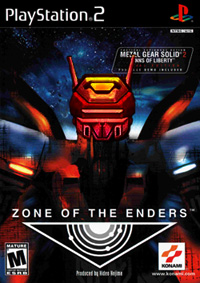
Zone of the Enders (2001)
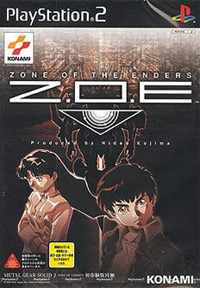
Zone of the Enders, or just plain ZOE, was a game set in the far off future in an O’Neill-esque colony in orbit around Jupiter. A force of mecha, known as orbital frames, infiltrate the colony in the hope of capturing a new experimental prototype orbital frame called Jehuty. As if the parallels with the original Gundam narrative aren’t striking enough: the game’s protagonist, a young boy by the name of Leo Steinbeck, stumbles upon Jehuty and is conveniently blown into its cockpit resulting in much mechanical ass kicking of the enemy forces.
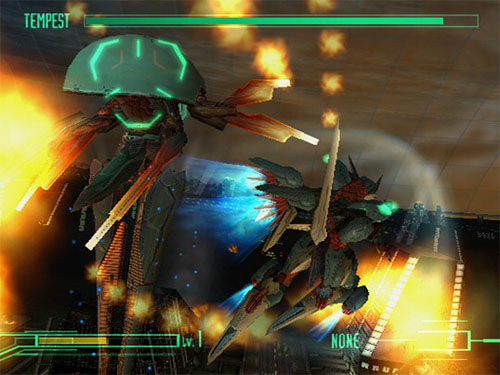
Functionally, the control of Jehuty was uncannily akin to piloting a Virtuaroid. In that, Jehuty had two main modes of combat; dash based long ranged attacks and circular strafing melee attacks. However, unlike a Virtuaroid, Jehuty had no means to cross the distance between ranged and melee combat effectively.
In Virtual On combat was linked by fixed length dashes, which interconnected until the player reached a close enough range to swipe them with a melee attack. ZOE had an analogue dash function, which meant there was no functional linkage between ranged and melee combat. This was compounded in the original ZOE due to the slow speed at which Jehuty moved and initiated its attacks.
The only real functional progression ZOE had over Virtual On was the means in which Jehuty could circle strafe its melee attacks in a spherical fashion. Admittedly the bulk of ZOE’s combat was similarly planar to Virtual On but the melee attacks could operate properly in three dimensions: as you circled underneath or above an enemy orbital frame to slice them from behind. Unfortunately the speed at which Jehuty moved made this rather mundane. Doubly so when the enemy units could manoeuvre at a greater speed in some instances, ultimately rendering the melee combat almost random in terms of its effectiveness.
Irritatingly, the initial narrative in the first ZOE game was actually quite sketchy and the game ended in a manner almost cursory. I say irritating, as the over arching conflict and back-story are genuinely fascinating and, in my opinion, rather well wrought. Thankfully, the second game does help to cover the meat of the narrative in a more thorough fashion, though more of this later.
The focus of ZOE though was predominantly that of the singleplayer progression, so direct comparisons with Virtual On are only really valid in terms of the game’s core mechanics and not the over arching narrative (as Virtual On technically doesn’t have a gaming narrative, though there is an awful lot of print based literature for Virtual On but it wouldn’t be fair to include that here). ZOE was trying, albeit in a very clumsy way, to re-create an anime narrative that gamers could partake in and that is laudable.
In addition, Yoji Shinkawa’s mechanical design was and remains incredibly progressive. Arguably, Shinkawa’s artistic proficiency helped give a much-needed lift to the mediocre and dated gaming functionality.
ZOE was also memorably bundled with a Metal Gear Solid 2 demo, to the point that almost everyone bought the game for the demo rather than the mecha game with its name on the box. It was a shrewd move, as the sales would have been a useful bargaining tactic to make more games and allow Kojima et al to creatively “branch out” into other genres.
Anubis (2003)
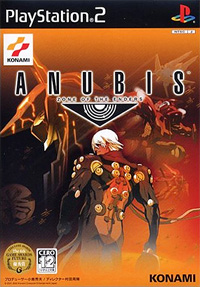
Two years after the first ZOE, Anubis was released. This was quite a substantial improvement over the original game; both in terms of combat speed and functional variety, but it still suffered from the same issue between the two modes of combat.
Jehuty also had a greater array of weapons at its disposal now and a far more effective grab move, as you could utilise elements of the environment and even enemy units as impromptu melee weapons. Yet, the two elements of combat were still very much separated from one another. Even later in the game when Jehuty is upgraded to the point it can use a function called “Zero Shift”, that crossed the gap between the two elements of combat by teleporting the player to melee range almost instantaneously, felt very clumsy as it required no tactics to use effectively.
Anubis also suffered several silent revisions in Japan improving boss balancing and enemy squad AI until that culminated in a final “Special Edition”, which more elegantly solved the issue between ranged and melee combat by having more intelligent squad based AI. This forced the player to approach groups of enemy orbital frames with greater care and an intensified sense of spatial awareness. Even then this improvement only accentuated the brilliance of Oratorio Tangram, which a few years prior had managed to incorporated all these elements in a seamless whole.
Anubis also finally covered the bleak narrative in far more detail. Gone where the shonky CG rendered cutscenes and instead replacing those with traditional cel-shaded animation, which fitted the whole mecha anime influence more convincingly.
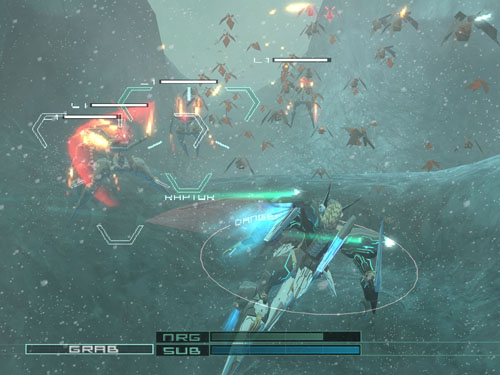
In all fairness, Anubis’ narrative was impressively executed. Not only was it very well written but it produced a functional context where Jehuty and the main protagonist, now by the name of Dingo Egret, really were the nexus that could turn the tide against the terrifyingly potent Bahram forces. Throughout the game there is an oppressive sense of foreboding that frames the action in a way that gaming doesn’t normally experience very often.
The only other mecha gaming series that comes close to this level of narrative is Armored Core but that has never been given an adequate localisation, mainly due to its subtlety most probably. Anubis is far more straight-laced in terms of its plot in comparison, so the subsequent localisation was more manageable.

Again, Shinkawa’s design work was breathtakingly executed. With a whole new graphical engine, using subtle elements of cel shading on some of the explosion effects and just a fantastic use of lighting, the mecha design was simply radiant. Even the brilliant useage of the Vic Viper fighter from Gradius as the basis for a transformable mecha was a stroke of genius. Thankfully, there is an excellent artbook available (as seen to your right) which shows the work that went into these designs and whilst Kojima bizarrely seems to take credit for the games (despite simply copying the core mechanics from Virtual On), it’s Shinkawa that should be given a greater level of creative credence. As he’s managed to encapsulate the real robot design mantra in a way that’s beautifully ethereal. Something almost no-one, bar Mamoru Nagano, has managed to successfully pull off.
Due to the lack of Metal Gear Solid demo bundled with Anubis, its sales were more inline with the game’s target demographic. Even in Japan it was very much a cult hit, doubly so abroad. This was unfortunate as Anubis was definitely a superior game when compared to ZOE but its actual popularity cast a more realistic shadow over the series’ future.
Zone of the Ending?
Despite the excellent Fist of Mars, which is a capable Super Robot Wars clone, the PlayStation 2 ZOE games leave a fair amount to be functionally desired.
Due to the barren landscape of mecha gaming outside of Japan, a large number of people fallaciously assume that games like ZOE and Anubis are without peers. That these games are even a pinnacle for the mecha gaming genre. Unfortunately, they aren’t. Functionally, ZOE still has issues that probably can’t be resolved (even the ACE games suffer from a similar, though less obvious, flaw). Kojima has sidetepped these problems by making greater emphasis on the narrative, to the point that an anime series has spawned from the games.
This is not to say that this isn’t a worthwhile endeavour, as gaming narrative is something that requires further development and it even fits well with the influences from mecha anime in this instance. Yet, you’re still controlling a mechanical avatar throughout the narrative and this is what ultimately constitutes the bulk of the game.
As such, it might be worth considering that the functionality should receive as much attention as the plot. At the very least hire Juro Watari and the remainder of the Virtual On team to do it properly.











Hmm, I dunno.
While I agree with alot of what you said here, I still am not quite sure what your grievance is with the shifting between long-range and close-range combat. Seems to me ZOE just makes it harder to approach a target as opposed to Virtual On, where you sorta have a “lock-on dash”, but I think whether or not that’s a “bad thing” is dependent on whether the player prefers a challenge or not.
“ZOE had an analogue dash function, which meant there was no functional linkage between ranged and melee combat”
This statement is kinda vague, what exactly do you mean by linkage. Maybe you ought to post two videos side by side. I don’t know, it seems to me that taking out the fixed dashes was deliberate choice in order to make for a more challenging game. I mean think about it, if they were copying VO I can’t imagine they would drop this function. It’s not like it’s technologically taxing.
I still think you should take another shot at 2nd Runner at the least. The whole time I’m reading this article I’m just not seeing this whole linking problem, and I played Virtual On so I’m all the more confused. I really think Subweapons, at least in 2nd Runner, make a huge difference. You oughta give it one more go.
VO works by having two ranges linked by fixed length vectored dashes. You stitch the dashes together, relative to your opponent, in order to get into the range you require.
When you remove the fixed length vectored dash in ZOE, you end up without anything to meaningfully link the two – hence the analogue comment and why the distance between the ranges feels empty.
The reasoning behind this was down to ZOE having multiple enemies and that fixed dashes were thought to be too constrictive (to be fair this was later proved to be true in both Virtual On Force and Marz, so the system only really works for two players).
The problem is that VO’s mechanics aren’t a good fit for what they wanted to implement – which is why Zero Shift is introduced in Anubis, as it “short-cuts” the range issue.
I’ve played the game a lot though, both the initial Japanese release and the Special Edition (across all the difficulties on each). I’m not sure what “one more go” would achieve to be really honest.
I read through both your review of 2nd Runner and this article a few times and even played the game again to try to understand what you mean by this whole “linkage” thing, but I’m still not seeing it.
The weird thing is that your 2nd Runner review is nearly ALL good things save for that one problem you had, so I’m a little perplexed why you gave it an abysmal 5/10. I really don’t see a problem with the connection between long-range and close-range combat, and I’ve never heard of anyone who thought that the linking between the two was so bad as to detract from the overall game experience. What really confuses me is that you give “Gundam VS Gundam NEXT Plus” an 8/10 and IMHO ZOE2 easily bests that game in terms of both control and the interplay between long-range and close range combat (can’t tell you the number of times my Mobile Suit has whiffed on a beam-saber attack due to the melee’s terrible homing system).
I think the biggest problem with your review of ZOE is two-fold. The first is that you really don’t expand on this whole issue of “linkage” between close and long range combat, you simply say that it “doesn’t work” or “feels awkward” without actually saying why. You need to break it down so that someone who never even touched the game can understand your view because honestly me and the people I know who’ve played ZOE2 have no clue what you’re referring to. For example you might say something like (and I’m making up stuff here but bear with me) “When flying your OF into close range your long range weapons abruptly stop working, so if an enemy approaches you rapidly it suddenly shakes the gameplay by forcibly swapping your weaponry in an awkward fashion” or something. A good review is
Opinion: X aspect of game is awkward
Cause: X lacks these-and-these aspects which it should have
Effect: Because of X’s aspects, it leads to Y result
Conclusion: Y is a bad result because it detraches from the gameplay experience by (insert reasons here)
Right now, the review is confusing and a bit abrupt because you’re essentially saying “VO had this thing, which ZOE doesn’t have and that feels strange.” The only “bad result” I can derive from your article is that you claim that the game makes you spend time “moving to” your enemies, but I think you’re taking a exploration-encounter-exploration style game and confusing it with VO, which is lacks the exploration aspects altogether. ZOE and ZOE2 give you large “maps” or “overworlds” call them what you like, and then allow you to explore them while on your way to a specific goal. You occasionally have encounters with enemy partys in the midst of this exploration, and the game then shifts into combat mode. But when you’re actually in-combat I don’t think the idea of “Oh man, I spend SO much time chasing my enemies down” even popped into my head, let alone took away from my fun. So I can only really guess that you’re referring to the fact that you spend time “transversing” these large maps, which isn’t really a fault in terms of the game as it’s deliberate. In fact, the only time I can think of when chasing down targets is a lengthy process is when it is a deliberate choice based on the challenge of the stage (for example the Vascillia Spider-attack and the Air Fight, both of those segments would be much too easy if you didn’t have some distance between you and the enemy).
The second big problem with the review is that you don’t really show a strong focus on experimenting with the combat in your gameplay videos, and don’t really seem to dig into the combat content in your review. I don’t think Subweapons are even mentioned in this article, let alone how they drastically can change the gameplay when integrated right. I know it seems arrogant but your gameplay videos really do make it look like you’re playing rather cautiously, so alot of the ZOE experts on various sites and IIRLCs are saying you’re a “newb” cause you don’t really touch upon those aspects of the gameplay, but then give their game a bad-score. You can’t really blame them for that though, they are the experts on the game and if they think you’re playing in a limited way and then giving the game a negative score on your site they are going to look down on your as a reviewer. I don’t know if I would even call myself an expert but I have to admit I also felt you were neglecting alot in your videos. That’s why I reccomend you’d play through the game again. Try to get involved in more melee combat and subweapons and don’t use the finger lasers so much. Then come back an post a video of your second playthrough showing that you did immerse yourself in the game experience, that way even if you still don’t like the game you have more of a foundation for saying so.
I dunno, it’s up to you. I can’t make you play through the game again and if you want to blow off the ZOE experts you can, but if you want to make your review better I think you should take what people are saying to you to heart. I mean, these people play ZOE ALOT, they do speedruns on Youtube and post alot of videos, so if they think you’re playing the game too cautiously I’m inclined to agree with them. It’s sort of like how in your Virtual On review you say that VO’s gameplay is something that throws alot of people who don’t really immerse themselves in it, so alot of people don’t really get into the full gameplay experience. I think it’s the same thing here, you need to play through ZOE2 again with a more gutsy style.
Anyway, it’s your own call again. But honestly I’m having a tough time really agreeing with you here.
I will agree that the score ZOE2 got shocked me as I consider it one of the top mecha games of all time.
What really threw me off is that your review was mostly postive and then it gets a 5? 0_o
I can find a ton more of abysmal mecha games that deserve a 5 and they are no way close to been as good as ZOE2, you have given the game a below average rating, which people I have shown this review have replied “he gave it a 5 0_o”
It is comming across to me that you are a VO fan and didnt like ZOE for surposedly ripping it off, the title of this very article makes me think that even more.
It is my personal opinion but when it comes to reviews I think you should judge the game on its own merits or if the game is a sequel then judge it on the one before, not on another franchise.
Wouldnt be nice if I said VO was rubbish because it doesnt measure upto AC or Gundam Vs.
I usually value your reviews, since I find them to be almost right to my thoughts.
In the end its your blog and you can say as you see fit, however I must admit after that review I find it hard to take what you say in your other reviews seriously and have to raise a eyebrow like a few other people do now.
The lack of linkage between ranges is bad because it drastically slows the pace of the game in relation to its other mechanics. This is especially noticeable because at each range the combat is suitably immediate but traversing between the ranges is much slower. This was a conscious decision to simplify the game by the respective teams and subsequently limited its higher end versus play (something the team knew full well and why the versus setup shares the same screen rather than a more competitive split-screen setup).
Virtual On, as a series, is mechanically more complex as you have to work within far more restrictive dashing constraints. This makes the versus element far more tactical but at the expense of a steeper learning curve. Complexity doesn’t necessarily mean the game is “better” though, as there are numerous mecha games that are overly complex to the detriment of how they play.
Regarding the Gundam Versus series and why Next Plus was rated higher, well the setup covers the linkage issue with the use of a finite boost dash that has to be managed (rather than the infinite variant seen in ZOE). In addition, that tamashii only covers Next Plus – not the Gundam Versus series as whole. The original Gundam Versus were similarly rife with problems, again to do with linkage between the ranges, it was only until the SEED iterations that the boost dash was implemented that helped fix the most of the issues (plus the removal of space based missions).
As for the ruse that I lack the skill to play the game and the supposed ZOE experts out there, please – if you want to make a point about the review or these articles then please do so. Undermining myself and other writers on this site in order to invalidate an opinion you disagree with won’t be tolerated.
Finally, a tamashii of 5/10 is not “abysmal”. It means the game is average in relation to other mecha games. Considering that the ZOE series’ sales were rather meagre and there have been no other sequels since Anubis, I think that appraisal is a fair one. Even the team were open about the series’ functional shortcomings too, so my take is hardly heretical.
Cacophanus, it sounds to me like you just don’t want to change your score.
I also feel your ZOE2 review doesn’t add up at all. The only real drawback you mentioned is this “linkage” thing, which you still explain rather vaguely, and then only support it by saying “ZOE team said this and that” and making all these claims about statistics without linking to any of your sources. It’s hard to take you seriously as a reviewer when your response basically “I’m an expert so I know what I’m talking about.” Your readers can’t just take that at face value as one’s self-proclaimed experience means next to nothing on the Internet. Evidence > “I read this/know this”
That’s also why people are looking down on your site when it comes to your ZOE experience. You claim to be experienced with the game, but your videos say completely otherwise. So while you can that we’re all out to “undermine your credibility” or otherwise call into question your ability to review the game (which is something even PAID critics lack immunity to), the fact of the matter is that doesn’t change anything. The fact remains that you are being told your playstyle is monotonic and does not accurately give credence to the work as a whole, both by average ZOE gamers and the experts who know the game mechanics far better then either you or I. The ironic and somewhat hypocritical thing is that you speak out on similar oversimplication and shallow gameplay experiences in your Vitual On review, so I have to agree with Chornus in that it does make you seem to be a VO fan who resents ZOE in some sense. Part of games is immersement in the mechanics to discover new experiences, and while you can claim otherwise, it is possible for a shallow playstyle to detract from an otherwise good game. In this case, almost everyone has expressed opinions suggesting you replay the game with a change of playstyles, as from what we’ve seen your choice of a VO esque tactic detrachted from several aspects of ZOE2 on the whole. You can write off all these people as ZOE fanboy-trolls, but consider that there are people out there with more experience then you, and therefore do have the authority to judge how you play the game and your review as a whole.
And seriously, what’s so hard about going through the game again? You can beat it in four hours, post a video showing off a more aggressive/diverse playstyle, and shut up everyone here by prooving you did give the game a fair shot. That, or spend hours upon hours responding to confused readers. Like it or not, this whole article comes off as somewhat questionable and decently bias, and has made past readers of MD (myself included) raise an eyebrow. How you respond ultimately reflects whether you value the opinions of your readers or feel yourself to be infalleable in this regard.
First off, I’ve never professed to be either an expert or infallible. I play a lot of mecha games and have for many years, not to mention won a few tournaments too, but I certainly do not feel that I “know it all”. If I did I would have stopped following this wonderfully diverse and inventive genre years ago (let alone start this site!).
I do think though that the aspersions cast towards myself and the site are more about indirectly dealing with my opinions, through undermining them, than openly discussing the matter at hand. After all, these supposedly advanced techniques haven’t been cited in any detail as yet and after investigating further much of this hidden depth appears to rather wishful thinking on the part of admittedly very dedicated fans.
Secondly, if you have a problem with the review it would make more sense to make your comment there rather than at the base of this feature that covers the series as a whole.
We also don’t adhere to a simple score system here either. As the tamashii number at the base of each review encapsulates the game in relation to the mecha mythos as a whole, it’s not a simple review “score” as we feel that mecha games cover a broad spectrum of functionality that ties into the wider influence borne primarily from manga and anime (something ZOE obviously falls under the remit of).
Anyway, as for specifics on the matter of mechanics linkage I’ve gone into a large amount of detail and specifics already, as shown above. This article is also a re-print of one from elsewhere, that also garnered very specific praise as per the detail of analysis and I quote:
“Great article–the terminology you use in some of those paragraphs is crazy-precise. I was trying to explain to a friend the principle in many mecha games where you have to match (or slightly exceed) a target’s lateral movement for your weapons to hit, but found I couldn’t explain it the way I wanted to. It’s good to know that there’s someone out there that can explain these kinds of things with accuracy.
I, too, was disappointed with the Zone of the Enders series. I think it was you, Kurokishi, who I talked about the game with before I finally got it, and I was really hoping that your criticisms were the result of extreme jadedness when it comes to mecha games. Unfortunately, despite the awesome art and narrative, I had to eventually agree–I don’t think I’ve wanted to like a game more than I actually did than Zone of the Enders 2. It should be a great game, but the many gameplay faults are so annoying, and so obvious, that it pulls down the art and narrative.”
To clarify on the time spent playing, the number quoted stipulated the time that the game could be easily completed in rather than the time actually played. As I went through both the original Japanese release and later the Special Edition over a good few weeks, though the former was the one reviewed. I do prefer the SE over the initial release however, as the boss battles were better gauged in terms of the difficulty and the squad AI was a lot more involved (something I mentioned above in fact).
There are also two videos in that review, as I also show the final boss fight with Anubis (one of the very few on YouTube). The video comments for both videos are also resoundingly positive in terms of how they are played as well. So this “lack of skill” gambit is suspicious, as it is obviously anomalous in relation to that (doubly so considering that both those videos have been freely available online for around 3 and a half years!).
Naturally, we do value the opinions of our readers but I’m sceptical of the intent and origin of these comments. I have no qualms capturing more footage though, as it’s fun but after browsing much of what has been posted since on YouTube I don’t see the necessity, as there’s nothing overly “skilful” about much of it (which is arguably the result of linkage issues I’ve already discussed at length).
In any case, if you have points you wish to discuss with the review, then feel free to do so there
Cacophanus Im going to asume most of your reply was at aqua because I sure wasnt undermining anyone.
Anyway on to your last part ok you know what you’re right and im wrong 5 is actually not abysmal but its not average either, its border line either way, right slap in the middle.
ZOE2 is not a game I associate in such manner.
Your next point is what really grinds my gears, you’re talking about sales.
To me sales have no reflection on whether a game is actually good or not, merely how popular it is, this has nothing to do with game mechanics, sound, and general overall gameplay.
Do bad designed games sell poorly? yes they sure do.
Do good designed games sell poorly? yes they sure do and there is the difference.
Okami and God Hand great games imo, but sold poorly, how you can phantom putting and justifying how well the game sells into your review score evaluation is quite questionable indeed.
Id expect such things from a lesser gaming site run by mainstream idiots that would give MW2 a 10/10 before they have even played the game for themselves, not a respected mecha game fan.
The mere fact we are talking about mecha games here, and lets face it apart from AC what else has decent worldwide numbers on consoles?
Im struggling to think of a game/series that even comes out worldwide tbh, their was the front mission series a fav of mine, but again that sold poorly and im betting squares atempt at westernizing the game with FM Evo will bomb too.
To me ZOE2 ended because the story was over for one and the mecha genre is not profitable enough for konami to try again especially with rising dev cost for next gen games.
In Japan it seems they are more happy with there mecha games on the arcade rather than consoles, which is probably why Gundam Vs franchise has been the leading mecha game for years with Border Breakers looking like its next in line.
My comment was indeed mostly aimed at Aqua, not you, so please don’t think I thought you were attempting to undermine anyone.
Your the sales comment is a fair one though but I meant that as an ancillary example really, not a defining reason per se. Whilst there are many good games that have sold poorly, with Metal Wolf Chaos being obviously notable, there are games that have been shelved due to their lack of popularity on account of their flaws. The ZOE games do definitely fall under this category and this isn’t the fault of the mecha genre either.
To put all this into perspective, the global sales of both ZOE games are eclipsed by many of the individual iterations of Armored Core. This is is not to say that Armored Core series is by any means faultless, as some entries are woeful, but some are exemplary and have appealed to gamers as a consequence. Hence the continued survival of the franchise.
I do think there is a wider, more positive, argument to be made with ZOE though – as it does have quite an upbeat fanbase (in Japan admittedly) – and I will admit that I have gone back and fired up both games recently. So as to re-appraise my thoughts on them (on account of these many comments here) but I still find the functional side of the games deeply flawed. I still adore Shinkawa’s designs however, despite the game’s shortcomings.
It’s also worth clarifying, that the Anubis review on this site is one I wrote at launch (and was actually printed in a magazine, if memory serves). Just so that people understand that it wasn’t written off the cuff recently, that’s all.
Ah ok, thats fair enough, although I know you’re not going to change your mind on the score it is not out the question after years you do re-reviews of certain games.
I know the guy on mahq has been recently going back and re reviewing shows he reviewed years ago just to give a better or more insightful review.
Of course this depends on how much time you have.
Anyway ive said all wanted to say on this matter, it was an interesting debate.
Well, I’ve actually been thinking of reviewing the Special Edition of Anubis – as it does improve on quite a lot of faults the original Japanese release had.
We’ll see though, as we have a big enough backlog of games to cover as it is!
Hey, heard about this on IIRC, thought I’d throw in my take.
First, I totally disagree with Cacophanus. ZOE2 is a phenomenal game. And yes, I have had many years experience with import mecha games such as the Super Robot Taisen series, ACW, AC, Gundam VS, VO, Chrome Hounds etc. None of these games IMHO come anywhere close to scratching the finese of the gameplay in Anubis (Taisen is the exception as it’s just such a drastically different series altogether). Cacophanus, your response to these posters is rather surprising to me. Nobody is calling your lack of skill into question, and suggesting people are trying to undermine your point or attack your credibility because they feel you played the game incorrectly is a pretty obvious attempt at a Scarecrow Arguement. You’ve been told, by people who have played the game far more then you, that your playstyle lacks experimentality. If you want to review the ZOE series you need to give it a fair score and looking up stuff on FAQs and fansites does not compensate for actually replaying the game from start to finish with a more melee oriented style. You need to actually do the work and post a video prooving you’ve done so. Second, it has nothing to do with skill, and I again really don’t have any idea where you’re getting that from. You can play through all of the ZOE games using only the Dash Shot, but is that really experiencing all the game has to offer? Not at all. That’s what is going on here with your gameplay style, and that’s what you need to fix. You can’t really use Youtube comments (or lackthereof) as evidence, as some people will find almost anything impressive and respond as such. What I think the majority of people are refering to is the fact that in your videos you use almost no melee combat, grabs, subweapons or combos. Of course, that’s excluding the mandatory Vector Cannon in the battleship fight and Zero Shift melee in the final battle. Finally, no, sales are no way to judge the quality of a game. ZOE2 sold poorly due to having its release date abruptly changed from the holiday season to late winter (crappy sales in general) due to massive competition in holiday 2002. Kojima commented on this, saying he takes full responsibility for Anubis’ lackluster success and feels that if he had kept the original release date ZOE would be as big a hit as his main series Metal Gear. And even without massive sales I’d say ZOE has done very well in that it became a massive cult-phenomenon and, according to Kojima, the second most popular Kojima series after Metal Gear. Also, a sequel to Anubis has only been delayed due to Kojima’s success with the Metal Gear franchise, not negative reactions to the game. Kojima quote:
“ZOE is a title that has an extremely large fanbase requesting a sequel. That holds especially true for The 2nd Runner, the sequel. That game was praised all over the world, and we still get a lot of intensely devoted adulation for that game. After Metal Gear Solid, it’s the Kojima Production title that has the largest and most dedicated fanbase. But there is a mountain of things that have to take priority over that, and we just haven’t been able to make it a reality yet. I’m positive in my heart, though, that I’ll be able to bring a sequel to all the fans someday.”
Even if you think all the people that post here are trolls, they have valid points. Points which you’re circumventing rather then dealing with.
I’m hardly circumventing them, as there are two articles already written and my numerous responses that specify the issues. Your argument that people aren’t calling my “lack of skill” into question, is also quite amusingly contradicted by your very own statement that I’ve “played the game incorrectly”. Put simply, make your argument and actually address the points raised in the review without a) trying to undermine the reviewer and b) dismissing the points out of hand as being “vague”.
Not one of the obvious ZOE fans posting here have done either as yet, despite writing comically long responses.
As for Kojima’s comments, well he is of course going to give something hopeful for the fans. He’s not an idiot and even he knows that the sales and overall lack of popularity of the series, compared to games like Armored Core (which are arguably a lot more hardcore and functionally demanding), means that Kojima and subsequently Konami will go where the money is (but he’s not about to piss off any kind of fanbase, regardless of how small it obviously is).
The issue with the original Japanese release was that you had clusters of enemies spread out over large areas in many of the missions (much like in the original ZOE). So you then had two games operating independently of one another; one at range and one at melee with nothing in-between (not to mention the abject tedium of trundling between groups of enemies). There was no functional link between the ranges, compared to Virtual On which had fixed length vectored dashes that stitched long range and melee combat together..
I understand the reasoning as to why they did this, as having a fixed lock with rigid dashes inside a complex environment is very difficult to handle – as Virtual On Marz showed – but Anubis’s lack of meaningful linkage between the two modes of attack meant that moving between them was really dull and uneventful (even with all the subweapons, though if anything they accentuated the range issue further).
The Special Edition began to fix this, with the squad AI seeking you out more – so making up the range on your behalf – but it was obvious that this was very lacking in the original release (which was the one I reviewed). Zero Shift consequently felt like a very clumsy “fix” when it came to linking the ranges, as it just teleported you between them effectively. It was the functional equivalent of breaking an egg open with a hammer; it works but the end result is pretty messy.
Other games have dealt with this linkage issue with far better results than ZOE as well, with the Another Century’s Episode games being notable. As you have a boost gauge which depletes with usage and the boost itself limits the movement of the mecha once initiated. So you have to do something between the ranges of attack and couple with the nuanced handling of each of the mecha meant that the final result for all three games was far more varied and engaging.
Anyway, I’m locking the comments for this feature for the time being as most of this is about the review. If you want to discuss that, then please do so.