



Reviews: Anubis (5/10)
Posted on : 06-09-2009 | By : Cacophanus | In : Reviews
Hardware: PlayStation 2
0
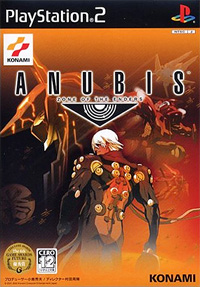 Set a few years after the first incarnation, the game starts with the player being re-introduced to the mechanical avatar of Egyptian death, Jehuty. Along with it’s new virile pilot, Dingo Egret. What follows is a truly impressive and epic narrative, after all the first game wasn’t the only part of the saga. Admittedly, the plucky little hero from the first game game, Leo Steinbuck, makes an appearance, but the overall narrative tone is far more mature and developed now. There has even been an animated movie and TV series too. Unfortunately, there is just too much focus on the narrative, to the point where it detracts from the overall game.
The actual game itself has been improved noticeably, Jehuty can do a lot more now. The old grab function, with its new implementation, adds a lot of spice to regular combat, but some of the boss fights fall foul of this new function to the point of gimmickry. As such, in many of the numerous boss fights the player has to grab an object and use it as a “guard” against an ensuing attack. So instead of gauging the combat mechanic in a gradual process, we have to endure lengthy boss encounters where we cannot directly attack our foe. Admittedly it is a useful and innovative function, but over used.
The overall game speed has also been increased, along with the advent of a multiple lock on function. The latter enables the player to target swarms of multiple enemies and then, consequently, release them from their mortal coil in a barrage of homing plasma death. The close combat has also been made more potent and intuitive, the latter more to do with the game’s increased speed than anything else.
Despite all these changes though, the faults of the original game’s mechanics still raise their ugly head.
Both ZOE and Anubis try to be two disparate game types simultaneously; a long range shooter and a three dimensional close combat game. Both of these mechanics work superbly on their own, it is only when you try and merge the two that it all falls apart. There is no segue between the two game mechanics, so the final result is that of brief moments of intense combat interspersed with the tedium of covering the distance between each enemy. Admittedly, when you are in the thick of combat and surrounded by enemies the above is not an issue. It is just getting to that point that takes an age. Thankfully, this is somewhat clumsily corrected later on in the game, with the addition of the Zero Shift function, but it is still a rather heavy handed device and shows that the game lacks any internal cohesion between its respective game mechanics.
Following on from this, many of the boss fights can be awfully dull and gimmicky. Having to time successive sword clashes in order for your opponent to lose composure, thus allowing the player to grab them and start deleting their AI, runs counter to a game that is obviously focused on direct combat.
Despite the game’s brevity, if you skip the cutscenes, there is still a wealth of secrets that remain to be unlocked. The much talked about 3D Gradius is in full effect (called Zoradius) and is a superb little diversion from the main campaign. Not to mention that both the attainment of Extra Missions and pilotable mecha for the (flawed) versus will have the dedicated player glued to the screen for a fair modicum of time. Unfortunately, a lot of the “Extra Mission” scenarios are merely in-game levels re-hashed with new objectives and the versus aspect of the game is implemented particularly poorly.
In the original ZOE, once the player completed the game, versus mode was unlocked. Instead of having splitscreen versus (or even iLink), as would be logical for a 3D combat game, only one player at any one time could be at the front of the screen. This creates an unnecessary and somewhat comical battle for the best view. Anubis still has this deficient system in full effect. It really is a shame, the combat engine and close-combat functionality has been improved and would really shine in a decent versus setup. Most certainly an opportunity lost.
On the upside, Anubis is a visually stunning game, probably the most aesthetically accomplished title on the PlayStation2 thus far. Yoji Shinkawa’s design work is also outstanding in its originality and is a joy to behold in game. The animated cutscenes are superbly undertaken too, despite their quantity. The game also has its fair share of epic in-game setpieces as well, and are a joy to partake in once they get into full swing. So there is a lot of good content, but it is just marred by the lack of internal game mechanic cohesion and the vast amount of unnecessary, and generic, narrative waffle.
In conclusion, Anubis is better than average but is woefully lacking compared to its other brethren from the same canon.
Tamashii: 5/10